Research
Hexapod Rescue Robot and Leg Optimization
A formal optimization of the morphing leg's geometry and footpath for search and rescue modes, and the design of the hexapod it will run on.
In simulation the optimized legs take search-mode steps about 12 times larger than the rescue-mode design, and an 11 kg robot turns out to be limited by foot friction, not motor torque.
My role. Kinematic model, optimization framework, hexapod design and analysis
Python / MATLAB / SolidWorks / MuJoCo / CubeMars AK60-6
The morphing leg showed that changing a five-bar linkage’s geometry changes both its workspace and its force. But the geometry I tested was symmetric and picked by hand.
This project asks what geometry is actually best for each mode, and designs the hexapod that will use it.
A note on the numbers. Force and step results below come from a quasi-static simulation, not hardware.
A more general leg model
I generalized the kinematics so the links don’t have to be symmetric and the ankle can sit at an offset angle. That gives seven design variables: the two actuated links, the two passive links, the motor separation, the ankle link, and the ankle offset.
- I derived the forward kinematics, inverse kinematics, and the foot Jacobian.
- I checked the model by confirming it reduces to the standard symmetric 5-bar when the new terms are zero.
- The ankle offset rotates the leg’s force ellipse without changing its size, which separates force direction from force magnitude.
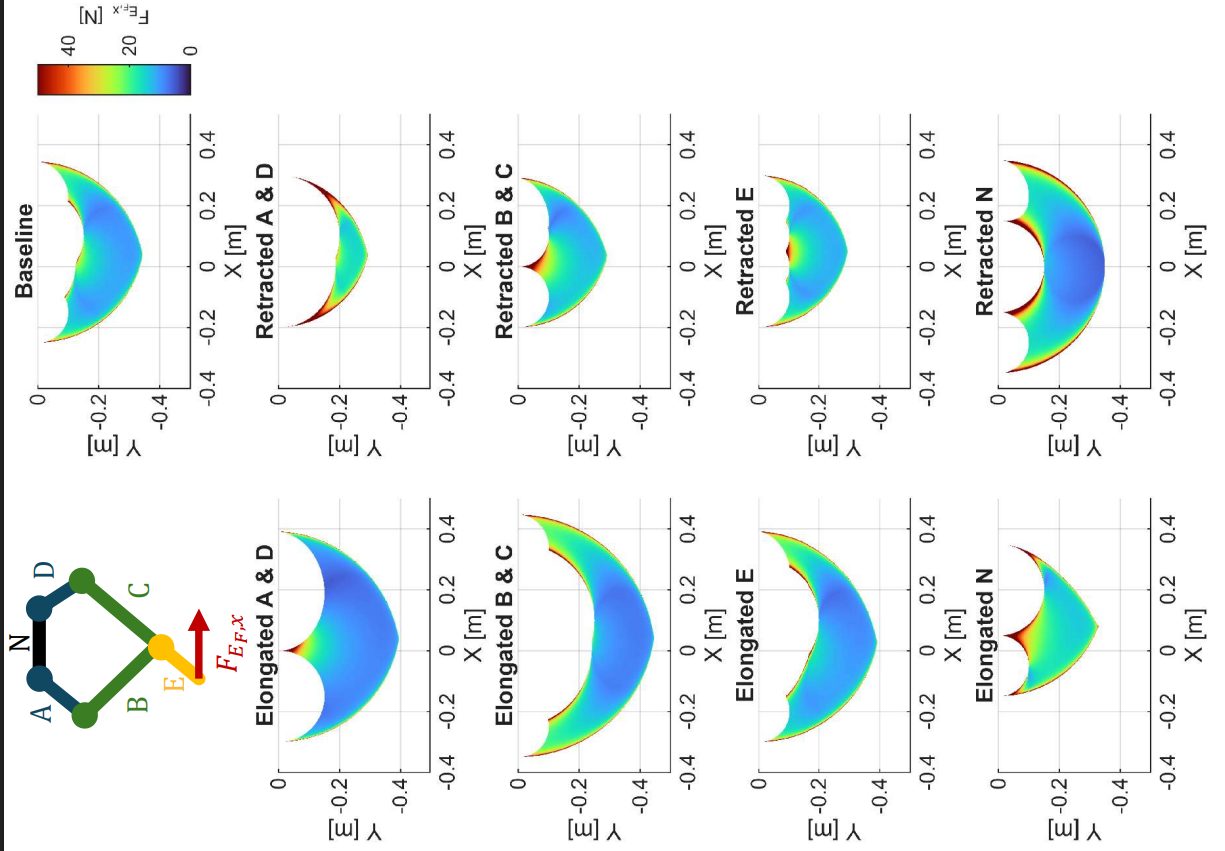
Rescue mode: the weakest point decides
A drag fails at the weakest point of the stance, not on average. So the optimizer maximizes the minimum horizontal force across the whole stance path.
Strong regions of a 5-bar’s workspace sit near singularities, where force transmission becomes unreliable. The optimizer is held to a Jacobian condition number of 10 or less, a bound taken from the AK60-6’s current-sensing accuracy rather than picked arbitrarily.
Other constraints: inverse kinematics must be feasible, the foot must clear the ground, and forward and inverse kinematics must agree. The objective is non-smooth, so I used multi-seed differential evolution followed by a Powell refinement.
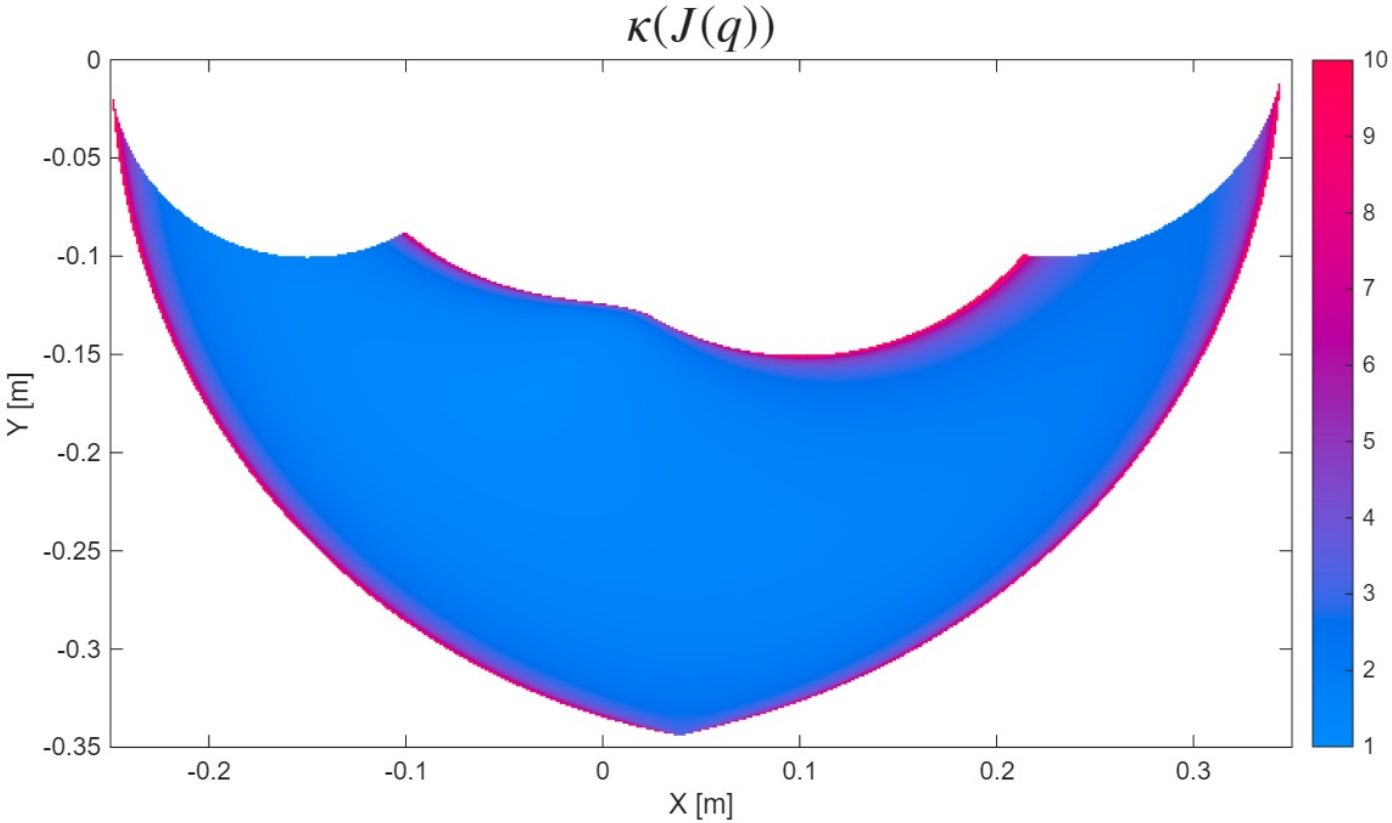
The real limit is friction
With six legs, at least three in contact, and two motors per leg, the single-leg result scales to the whole robot.
- Motor limit: at about 26 N per N·m of torque, roughly 468 N of drag force.
- Friction limit: a rubber foot on dry concrete (μ = 0.6) under an 11 kg robot slips at about 65 N.
- Target: dragging an 8 kg load (a scaled stand-in for a casualty) needs about 47 N, leaving a 38% margin before slipping.
The design is friction-limited. Robot weight and foot friction, not motor torque or leg geometry, decide how much it can drag. Reducing robot weight directly reduces drag capacity.
Search mode and footpath shape
For search mode the same framework maximizes stride length and chassis clearance, subject to a minimum vertical force. In simulation the optimized geometry gives a 44.3 cm stride and 16.2 cm step height. That is a 718 cm² step envelope against 57 cm² for the rescue reference, about 12.6 times larger.
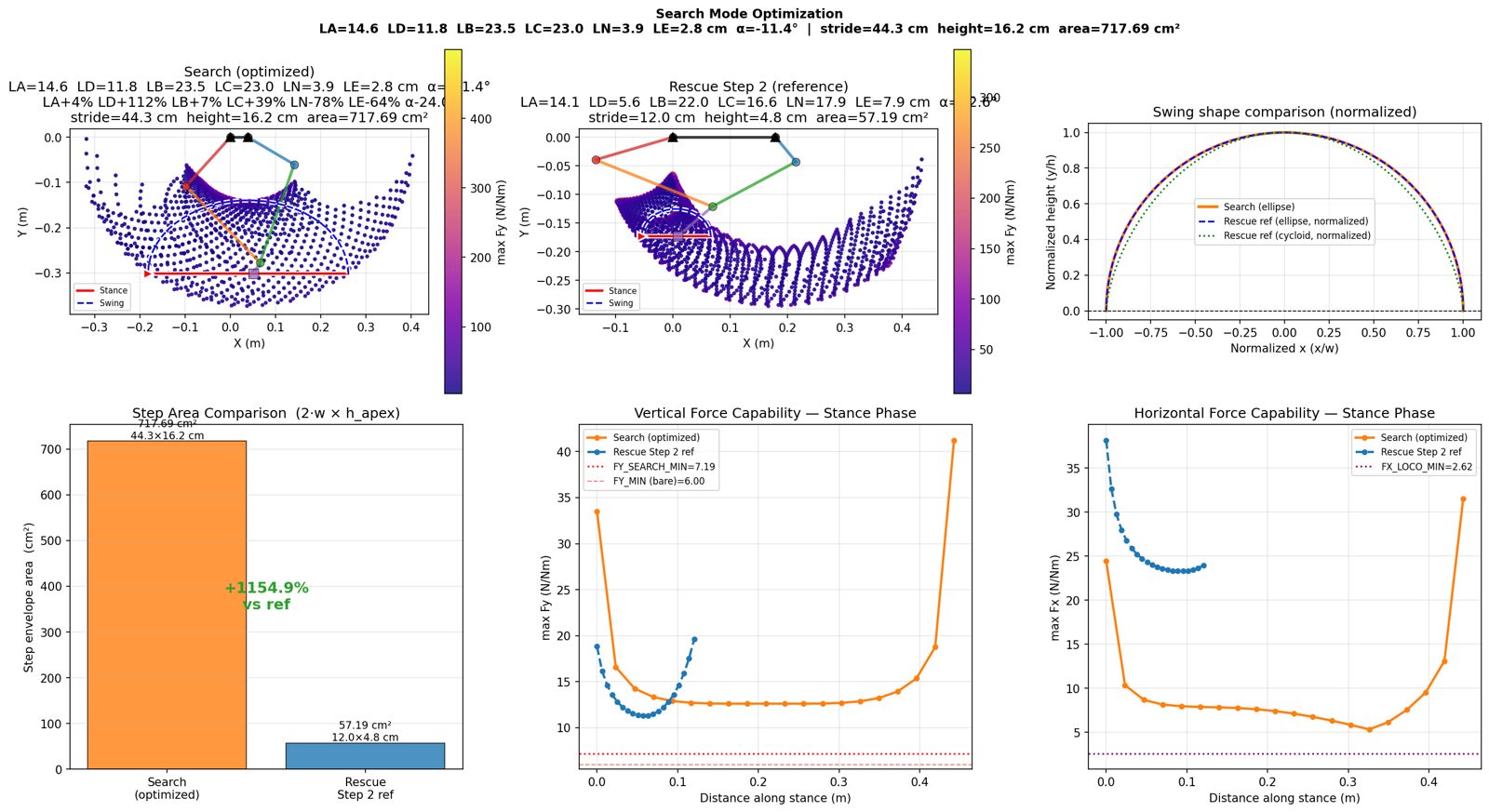
Optimized links: 14.6, 11.8, 23.5, 23.0, and 2.8 cm, a 3.9 cm motor separation, and an ankle offset of −11.4°.
Choosing the swing path
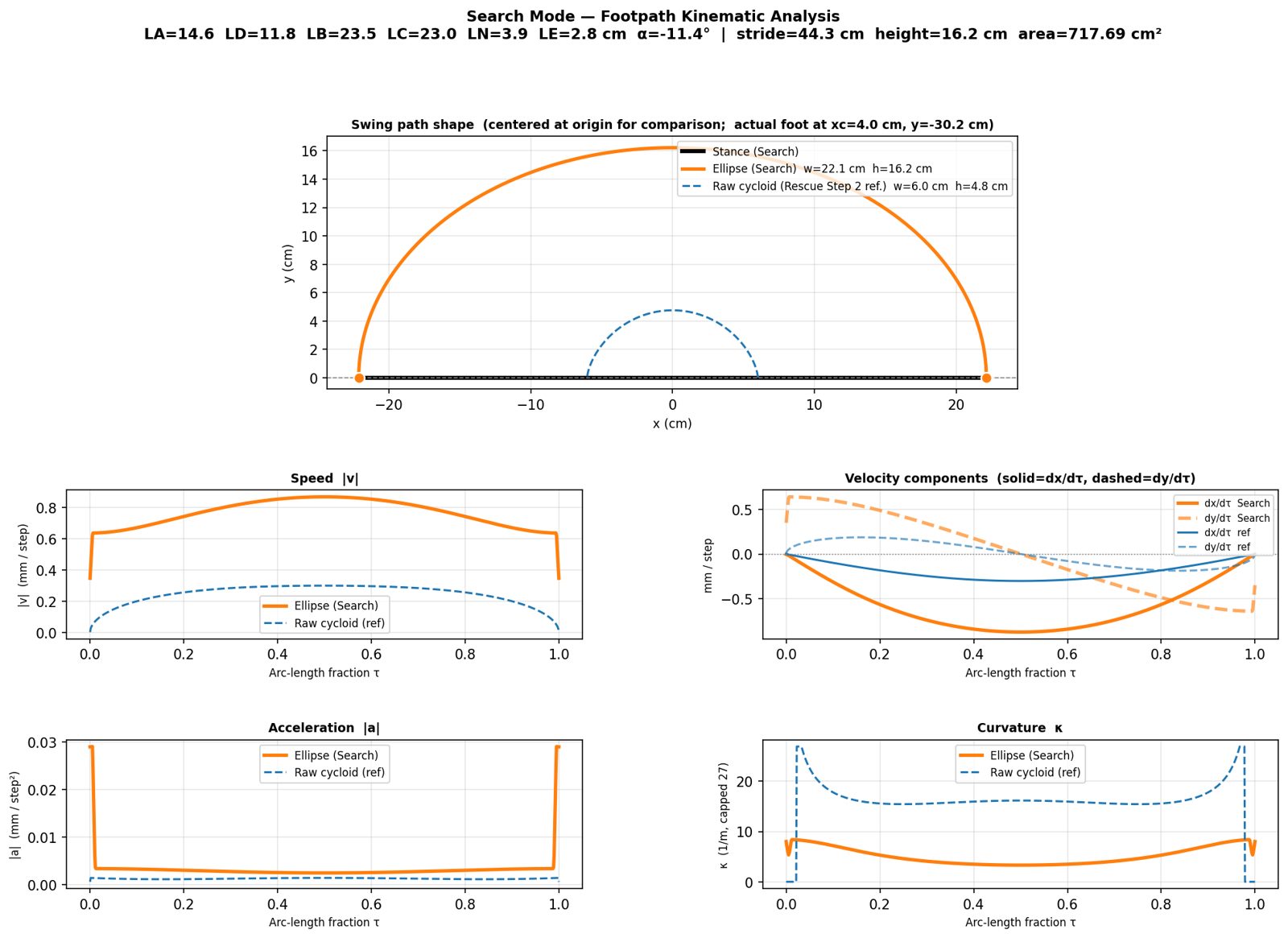
I compared six candidate swing paths: a capsule, a pure half-ellipse, a cycloid with blended ends, the raw cycloid, an ellipse with Bézier blends, and a degree-6 polynomial. The pure half-ellipse won.
- It needs no blend. Its tangent is vertical at the ground, so the foot touches down moving horizontally.
- Bézier blends fail by construction. A quintic Bézier that turns about 90° in a short distance always produces an inflection point.
- A raw cycloid has a cusp with unbounded curvature at touchdown, which a real controller can’t follow. I made sure not to hide that by resampling before differentiating.
The hexapod
The platform is a six-legged robot with the morphing 5-bar on every leg. The mass budget comes to 10.76 kg against an 11 kg target:
- Twelve AK60-6 motors: 4.56 kg
- Aluminum square-tube body: 2.10 kg
- PLA joints and mounts: 2.00 kg
- Electronics and battery: 1.60 kg
- Laser-cut plywood links: 0.50 kg
I chose the actuator by comparing eleven candidates on price, rated torque, weight, size, and whether a driver and encoder are built in, including the Eaglepower LA8308 and the CubeMars AK60, AK70, AK80, and AK90 families. The AK60-6 (3 N·m rated, 9 N·m peak, 6:1 planetary, 380 g) was the best fit for a robot this light.
What’s next
The quasi-static model prescribes how the robot walks and then optimizes the geometry for that gait, so the answer is only optimal for the assumed behavior. A real hexapod also chooses its posture, leg coordination, and contacts.
The next stage is a bilevel reinforcement learning framework. The outer loop searches over leg geometry, starting from this result instead of at random. The inner loop trains a walking policy for each candidate, with separate objectives for search and rescue.
The central question: does the geometry found by optimization still hold once the robot is free to discover its own behavior? If the two differ, learning found something the optimizer couldn’t. If they agree, the optimum has been validated independently. I proposed the optimization stage as a funding proposal for MAE 269 with Dillan Selitsch.