Research
Adaptive Morphing Leg for Search and Rescue
A reconfigurable 5-bar leg that switches between fast traversal and high-force load dragging. Published at ICRA 2026.
Changing link lengths raised measured foot force from 58 N to 106 N on the same motors, and the biped used it to drag a 2.3 kg load.
My role. Mechanical design, prototyping, and experimental validation. Co-first author.
SolidWorks / Ansys FEA / Python / CAN / CubeMars AK60-6
Search and rescue robots have two jobs that pull against each other. They need to cover rough ground fast, then pull a heavy load once they reach someone. A leg tuned for one job is usually poor at the other.
This leg gets both by changing shape. It is a 5-bar linkage whose link lengths change while the robot is running, so the same motors can trade speed for force on demand.
Two modes, one leg
Search mode
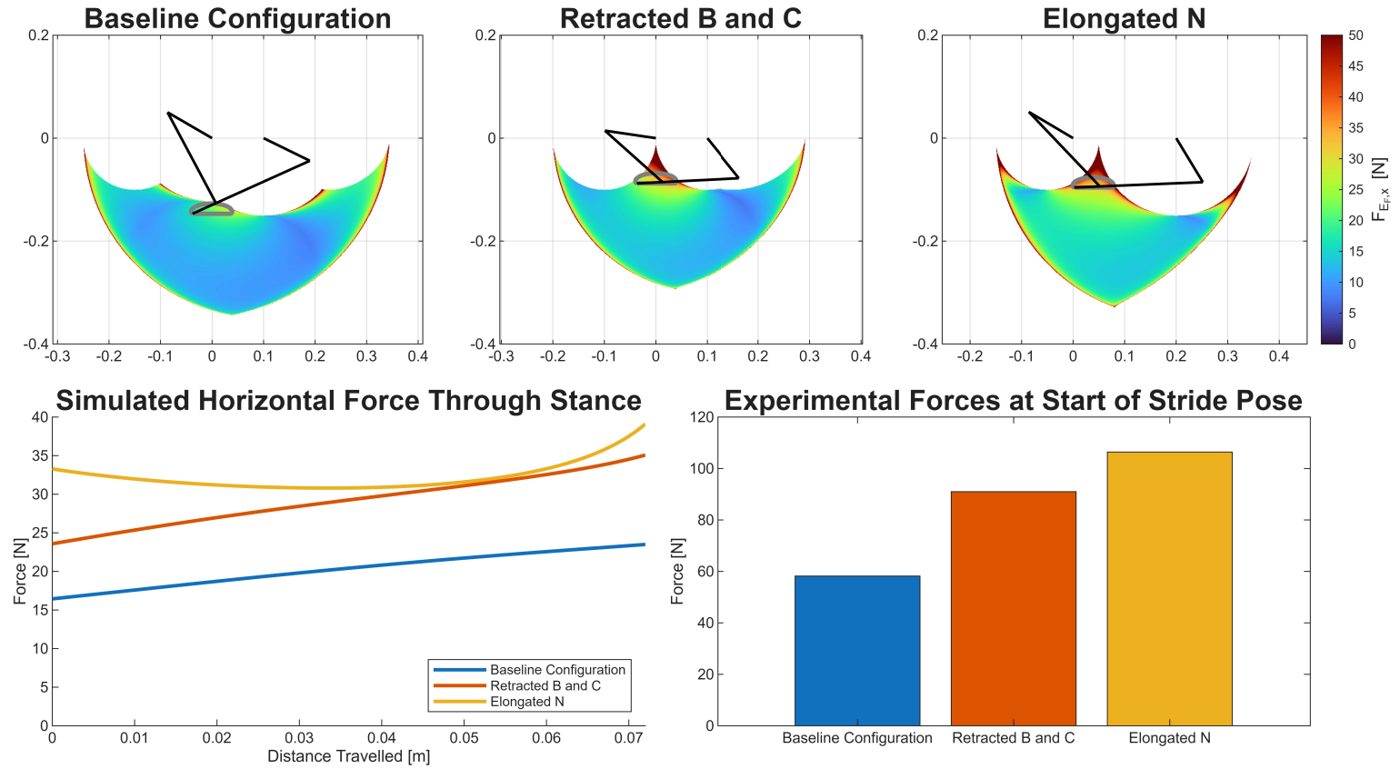
Passive links extend and the ground link retracts. The foot can reach farther, clear bigger obstacles, and move faster.
Rescue mode
Passive links retract and the ground link extends. The workspace shrinks into a region of high force, good for short dragging steps.
A gear change alters the torque-speed ratio but not where the foot can reach. Changing link lengths does both.
Results
I measured peak static pushing force at the foot with a crane scale, with motor bus current limited to 1 A and five trials per configuration.
- Baseline: 58 ± 1 N
- Retracted passive links: 91 ± 1 N (+57%)
- Elongated ground link: 106 ± 2 N (+83%)
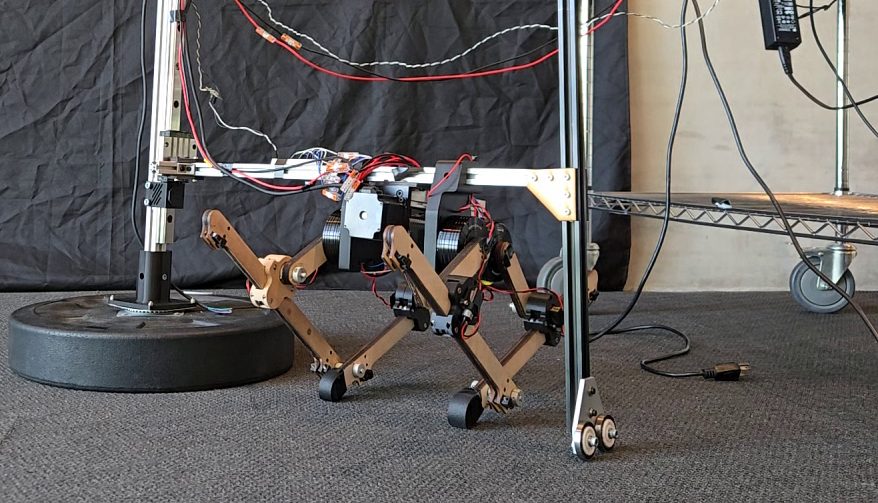
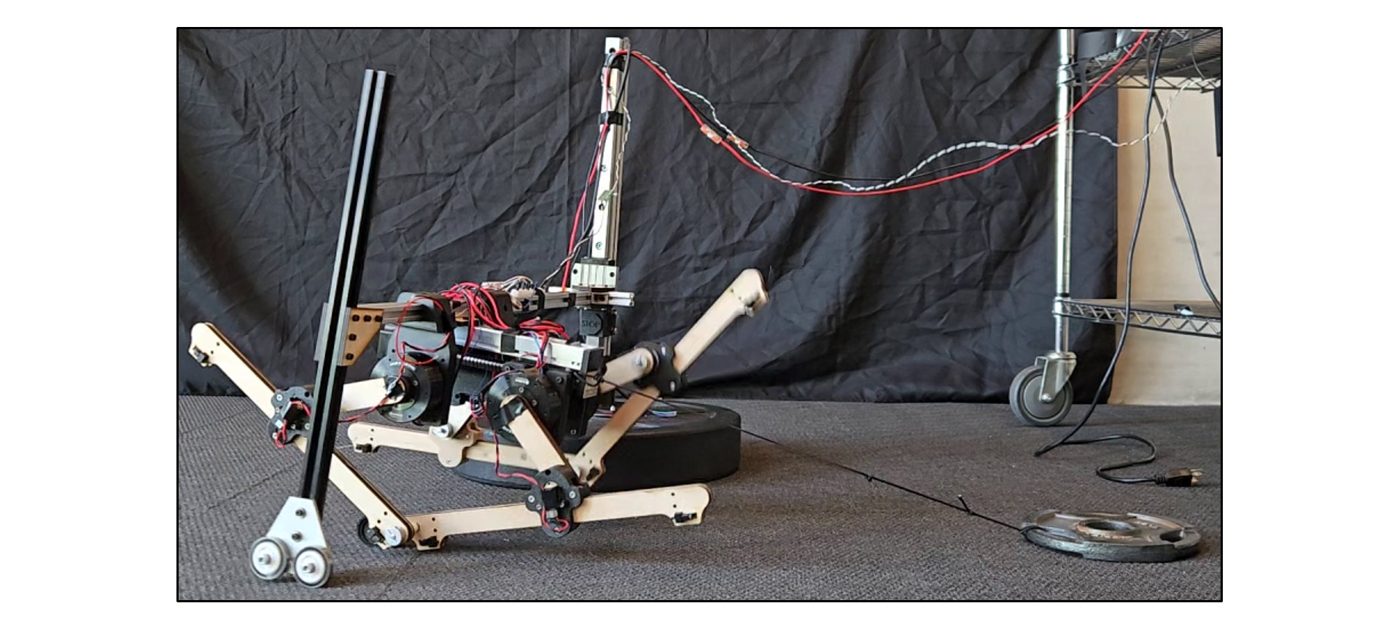
On the biped, the robot follows a foot path, walks, then reconfigures and drags a load of at least 5 lb (2.3 kg) with the passive links retracted to 18 cm and the ground link extended to 13 cm.
How it’s built
The testbed
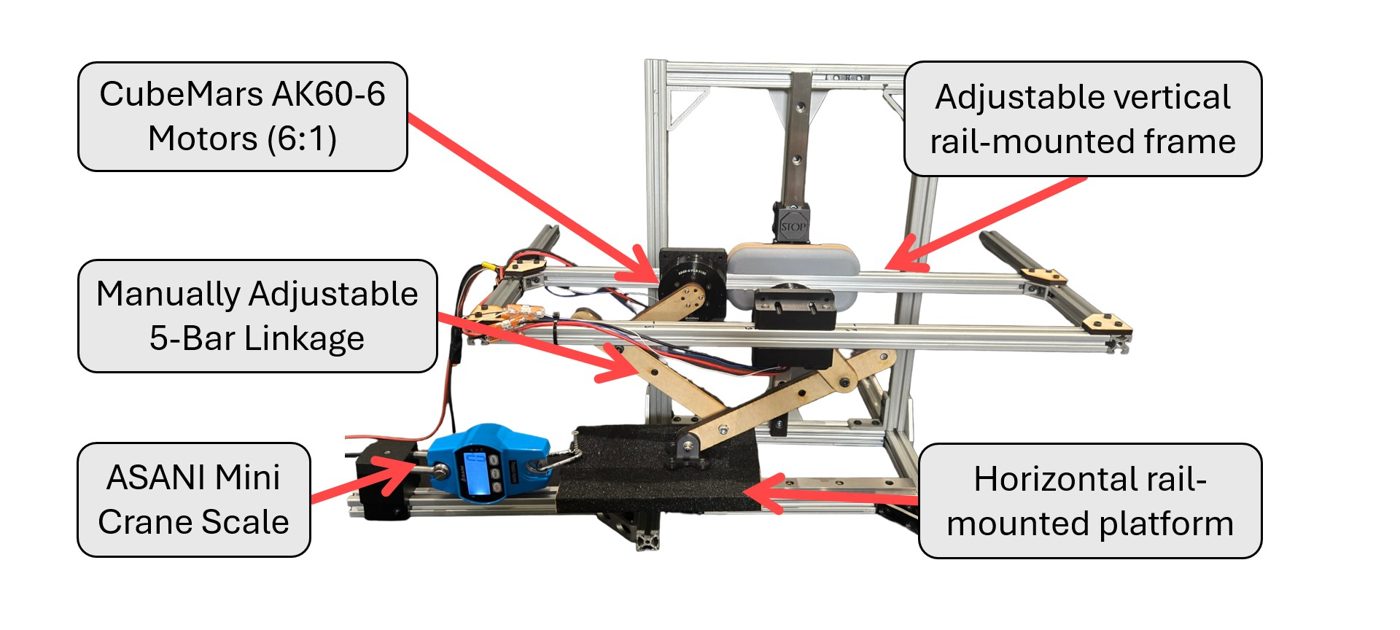
A planar testbed with interchangeable link mounts lets me swap in different 5-bar geometries and measure each one. Two CubeMars AK60-6 BLDC motors drive the joints, and I compared measured force against the model’s prediction (τ = Jᵀ·F).
Capstan-driven reconfiguration
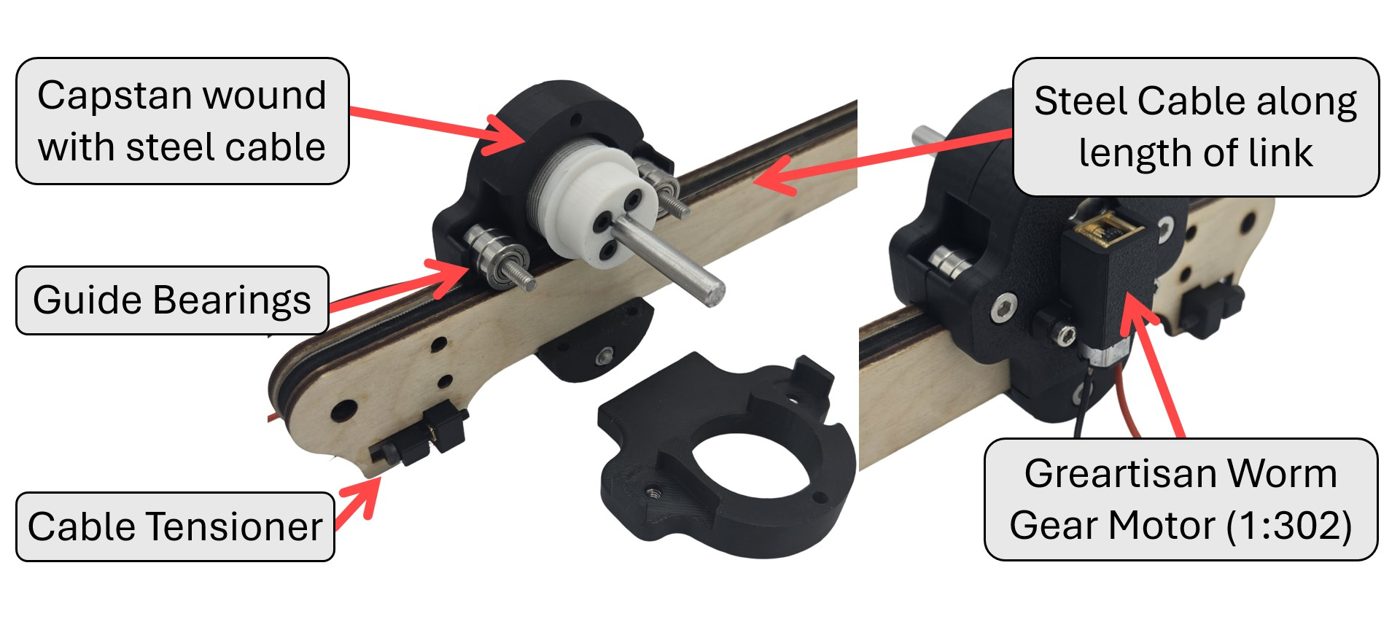
A worm-gear motor winds a tensioned steel cable around a spool to change a link’s length from 64 to 273 mm.
- It can’t be backdriven, so the leg holds its shape under load without drawing power.
- The cable drive is smooth and has no backlash.
Control and the biped
I wrote the Python position control that runs over CAN and coordinates the joint motors with the gait cycle and the reconfiguration actuators.
The biped has four AK60-6 joint motors, capstan drives for the passive links, and a stepper-driven linear stage for the ground link. It hangs from a boom arm during testing.
What didn’t work yet
- The biped was tested on a boom arm, not free-standing.
- The feet slipped during dynamic load dragging.
- Terrain interaction and friction aren’t modeled.
- High-force regions sit near singularities and have to be avoided.
These are the gaps the next stage targets.
Where it came from
The project began as my senior capstone (MAE 156A and 156B), sponsored by ARCLab. The brief was a hexapod leg, made from wood and 3D-printed parts, that could cover ground quickly and also drag a heavy load.
Our team set out to compare three scaled leg designs: a 5-bar pantograph, a swinging 4-bar, and a modified Theo Jansen linkage with an extra degree of freedom. The plan was to use kinematic simulation to set each walk cycle, run them under PID control, and rank them by maximum pushing force in high-torque mode against stride length in high-speed mode. The 5-bar is the design that went forward.
ICRA 2026
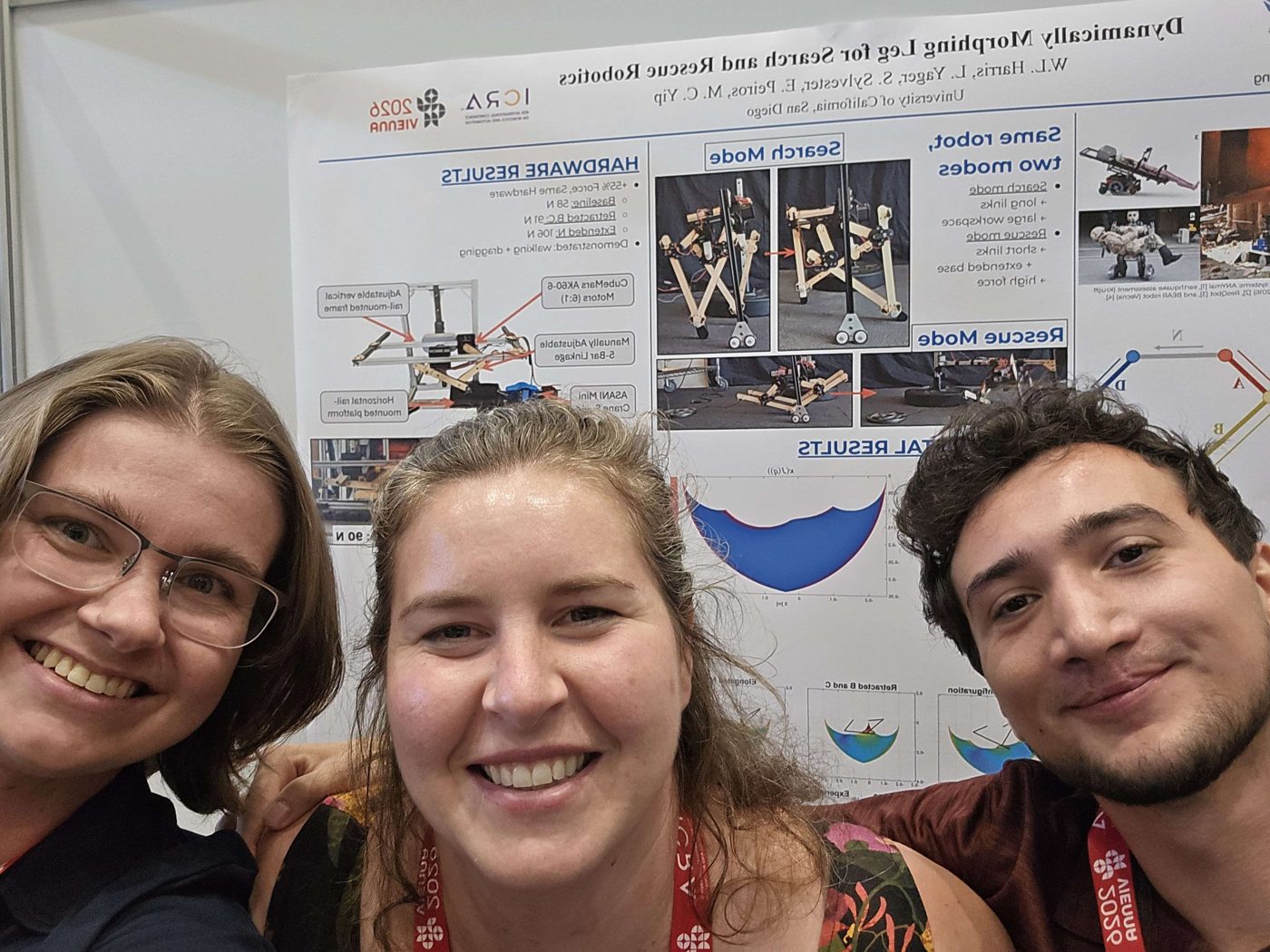
The paper was accepted to ICRA 2026, and I presented the poster there.
What’s next
The single-leg result doesn’t say how the legs should work together with the body. I’ve since built a formal optimization of the leg’s geometry and footpath, and I’m planning a reinforcement learning approach across all legs. It’s covered in Hexapod Rescue Robot and Leg Optimization.